John O’Donnell
18 November 2026
A review of 73 Australian and international case studies shows that planned burning contributes to community protection, firefighter safety, biodiversity conservation, cultural land management, catchment protection, carbon reduction and long-term landscape resilience.
Read full article here
Australia is a fire continent. Many of its forests, woodlands and savannas evolved with frequent, generally low-intensity fire. For thousands of years Aboriginal people actively managed landscapes using cultural burning, creating fine-scale mosaics of vegetation that supported biodiversity, facilitated movement and hunting, and reduced the likelihood of extensive destructive fires. Following European settlement, the disruption of traditional fire management, coupled with changing land uses and periods of fire exclusion, altered many fire regimes and contributed to fuel accumulation across large areas of the landscape.
The evidence reviewed demonstrates that appropriately applied planned burning can help restore some of the ecological and operational benefits associated with more frequent fire.
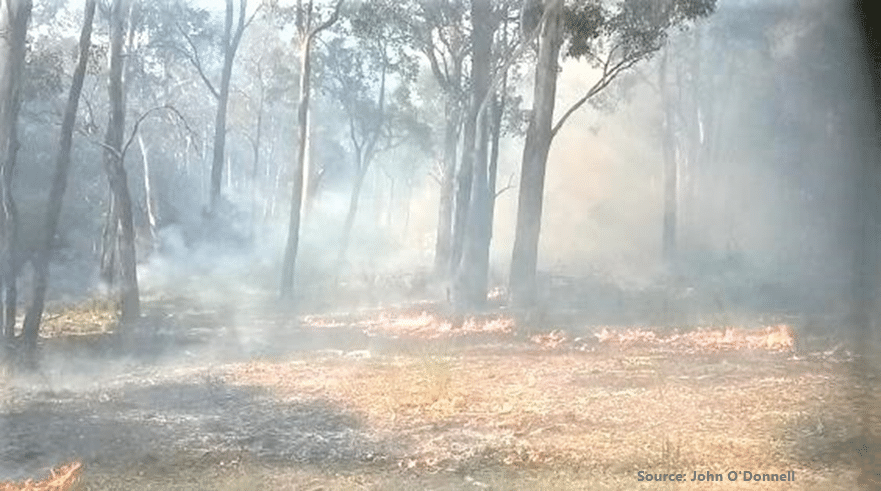
One of the strongest themes emerging from the case studies is the role of planned burning in reducing the extent and severity of major bushfires. Examples from Victoria, New South Wales, Queensland, Western Australia and overseas repeatedly show bushfires slowing, dropping from the canopy to the ground, or becoming more manageable when they encounter recently treated areas. During Victoria’s Six Mile Fire, a strategically located planned burn undertaken nine months earlier helped protect communities including Nowa Nowa and Lake Tyers Beach. In Queensland’s Broadwater Fire, modelling indicated that a recent prescribed burn significantly reduced fire spread and likely prevented additional house losses. Similar outcomes were observed during the Orroral Fire in the ACT and a range of major fires in California and Colorado.
These changes in fire behaviour are important because they create opportunities for successful suppression. Lower flame heights, reduced spotting and slower rates of spread enable firefighters to undertake direct attack and establish containment lines more safely and effectively. Numerous case studies demonstrated how fuel-reduced areas became critical anchor points during suppression operations. In many instances, prescribed burning did not stop fires entirely, but it changed fire behaviour enough to improve operational outcomes and reduce community impacts.
The review also highlights the often-overlooked relationship between planned burning and firefighter safety. Extreme bushfires create dangerous operating conditions characterised by intense heat, unstable trees, limited visibility, rapid fire spread and restricted escape options. Research and operational experience suggest that reducing fuel loads can moderate these hazards by lowering fire intensity and improving access. Fuel-reduced corridors along roads and fire trails can improve access and egress for crews while creating safer locations from which suppression activities can occur.
Beyond operational benefits, planned burning plays a significant role in supporting ecological resilience. Many Australian ecosystems evolved with recurrent fire and depend upon appropriate fire regimes to maintain ecological function. Repeated low-intensity burning can sustain habitat diversity, improve regeneration opportunities and reduce the likelihood of large, landscape-scale high-severity fires.
The review identified numerous examples where carefully applied fire delivered positive ecological and often cultural outcomes. Indigenous-led burning programs in northern Australia have helped restore more natural fire patterns while reducing extensive late dry season wildfires. The Banbai Rangers cultural burning program in northern New South Wales demonstrated that ecological burns could reduce fuel loads while protecting threatened plant species and maintaining habitat values. Australian Wildlife Conservancy programs across northern Australia have shown that strategic early dry season burning can reduce destructive wildfires while improving conditions for native wildlife.
The importance of Indigenous fire stewardship emerged as a recurring theme throughout the review. Contemporary Indigenous ranger programs combine traditional ecological knowledge with modern technologies such as satellite monitoring, aerial ignition and carbon accounting systems. In the Kimberley and Arnhem Land, Indigenous fire management programs have not only reduced the occurrence of large late dry season fires but also generated carbon abatement outcomes, supported employment and strengthened cultural connections to Country.
Catchment protection provides another important benefit. High-severity bushfires often cause extensive erosion, water quality degradation and damage to aquatic ecosystems. Several case studies documented significant post-fire sediment movement, nutrient losses and impacts on freshwater habitats following major bushfires. By reducing the likelihood and extent of severe fires, planned burning can help protect drinking water supplies, reservoirs, streams and rivers from these damaging consequences.
Economic considerations are also increasingly important. Large bushfires impose enormous costs through suppression activities, infrastructure damage, insurance losses, environmental recovery and impacts on regional economies. While prescribed burning programs require sustained investment, multiple case studies indicate that the costs of treatment are often small compared with the potential losses associated with catastrophic bushfires. Examples from Australia and North America demonstrate how relatively modest fuel management investments have contributed to the protection of communities, infrastructure and environmental assets worth hundreds of millions of dollars.
An important finding from the case studies is that planned burning often delivers more than single benefits. The most successful programs generated multiple outcomes simultaneously. Indigenous burning programs improved biodiversity, reduced emissions and strengthened cultural connections. Fuel reduction treatments supported community protection while improving suppression opportunities. Ecological burning restored habitat diversity while reducing future bushfire risk. These interconnected outcomes demonstrate that planned burning should not be viewed simply as a hazard reduction tool, but as a broader land management practice capable of delivering cultural, ecological, social and economic benefits.
Across Australia and internationally, the case studies point towards a consistent conclusion. When appropriately planned and implemented, planned burning can reduce bushfire impacts, improve firefighter safety, support biodiversity conservation, protect catchments, strengthen cultural land management and contribute to more resilient landscapes. In an era of growing bushfire challenges, the evidence suggests that planned burning deserves to remain a key component of integrated bushfire and land management strategies.
As debates continue about the future of fire management, it is important that decisions are informed by the full breadth of available evidence. The lessons from these case studies show that planned burning is about far more than only fuel reduction.