Read full report here.
Reducing bushfire extent, a key benefit of prescribed burning [AU]
![Reducing bushfire extent, a key benefit of prescribed burning [AU] Reducing bushfire extent, a key benefit of prescribed burning [AU]](https://volunteerfirefighters.org.au/wp-content/uploads/2026/06/Pages-From-Reducing-bushfire-extent-a-key-benefit-of-prescribed-burning-AU_1-750x350.jpg)

![Reducing bushfire extent, a key benefit of prescribed burning [AU] Reducing bushfire extent, a key benefit of prescribed burning [AU]](https://volunteerfirefighters.org.au/wp-content/uploads/2026/06/Pages-From-Reducing-bushfire-extent-a-key-benefit-of-prescribed-burning-AU_1-750x350.jpg)
Read full report here.

John O’Donnell Assessment of fire management across south east Australia, including concerns, consequences, costs and opportunities Introduction Across Australia the 2019/ 20 bushfires burnt 18.74 million hectares across Australia, much of the areas at high intensity, 34 were lives lost

Opinion Piece John O’Donnell 15 May 2024 Increasing cost of living and rising insurance costs for businesses and homeowners in Australia. It’s time for dramatically increased disaster mitigation action Opinion Piece John O’Donnell 15 May 2024 Introduction Increased costs of

An indepth study by John O’Donnell looks back on all the major house and structure losses associated with major fires and distills the recommendations from these fires into 24 key principles in regards to town and city bushfire protection.
You can download your copy from the story.

A hard hitting article by the extremely knowledgable Vic Jurkis. Please read ….

We highlight farmer Martin Tebbutt’s fight with the NSW state bureaucracy for the right to clear a fire track around his property.
In our summary we examine the issues surrounding the Bushfire Envirjonmental Code, which is in need of a complete revision.

Capital Community Radio has produced a three-part radio play commemorating the bravery and stoicism of all those involved in the fires at Dwellingup in 1961. These podcasts were created from the actual experiences and memories of survivors. Each part runs for about 15 to 20 minutes.
Well worth a listen.

The team at the Charles Darwin University’s Darwin Centre for Bushfire Research has been working with Indigenous land managers, conservation, research and government organisations in northern Australia for the last 25 years to find more effective ways to manage wildfires.
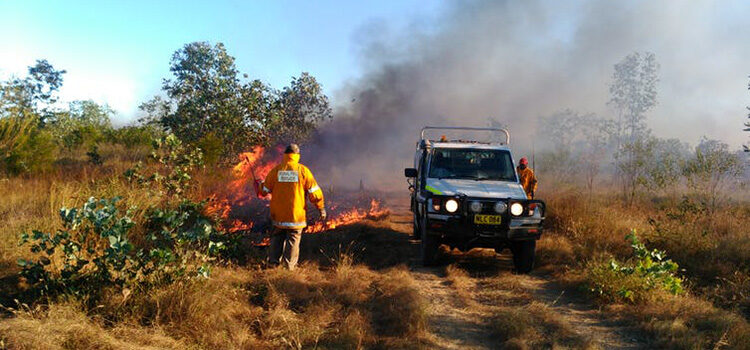
These collaborations have led to a new approach, blending modern scientific knowledge with traditional Indigenous land management practices to reduce bushfire risk.
How? By reducing fuel load through a patchy mosaic of small, low intensity, burns early in the fire season that cut the risk of late dry season fires when greenhouse gas emissions are much greater.

Of all the factors that contribute to the intensity of a fire (temperature, wind speed, humidity, topography, fuel moisture and fuel load), only fuel load can be readily modified by human effort, but bearing in mind that since the industrial revolution it is now clear that humans have also modified the world’s temperature, and action on emissions may eventually assist to bring this down.
Citation: Emergency Leaders for Climate Action

As bushfires peaked in the Australian summer of 2019-20, we heard a lot of the myth of climate change as the prime cause of the flames’ spread and severity. In this article, Christine Finlay addresses climate change and a second myth, mostly promoted by politicians and leaders of bushfire management organisations: that an appropriate response is to promise a thorough review of bushfire management (via royal commissions or otherwise) while pre-emptively pouring yet more taxpayer dollars into fire-fighting organisations and aerial firefighting, in particular. This is the latest instance of a repeated pattern, more likely to worsen rather than improve the situation.