I have come to despair over the bushfire situation in Australia. It has gone from bad to worse over the last 25 years, with our bushfire authorities increasingly opting to reject “the Australian Approach” (built upon pre-emptive fuel reduction) in favour of “the American Approach” (using expensive technology to fight fires after they start). In adopting this futile approach, bushfire authorities have aligned themselves with the green academics who oppose fuel reduction. The result is more and worse bushfire damage to the detriment of Australians and our environment, including its biodiversity.
Better forest management can help prevent bushfire disasters

Fuel reduction in the vast forests behind the communities along the Great Ocean Road have been neglected for decades.
How many disasters must we have, and how much public and private money needs to be spent, before we stop accepting a situation that can and should be avoided?
Victoria bushfires stoked by green vote
The following article was written for The Australian newspaper back in 2009.
The author, David Packham, a bushfire scientist for more than 50 years, said that “it has been a difficult lesson for me to accept that despite the severe damage to our forests and even a fatal fire in our nation’s capital, the political decision has been to do nothing that will change the extreme threat to which our forests and rural lands are exposed”.
Seven year later and nothing has changed… Is anyone listening…
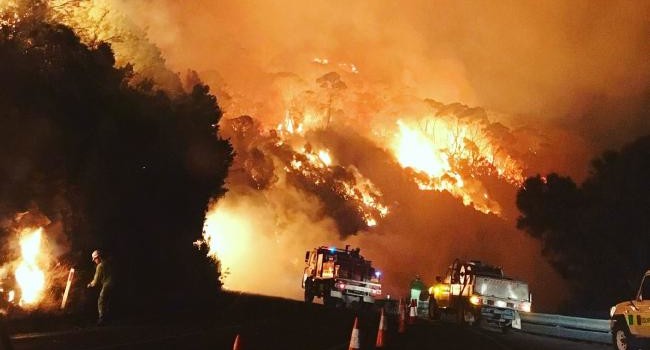
Great Ocean Road bushfire bill to exceed $100m

Stories like this one in the Australian are becoming way too frequent when the solution is low cost by comparison. These costs extend way beyond the public purse, there is a massive cost to our environment, local business and economy. A rethink of our hazard reduction targets is long overdue.
In reference to the article (The Australian – Dec 28, 2015) one of our readers said “Give the Volunteers back full control and get back to realistic hazard reduction targets. If a politician stepped up and made that decision, we’ll save lives, homes, our wildlife and heaps of money that could be better spent on hospital, infrastructure, the drug problem… the list goes on…”
Bushfire Death Trap
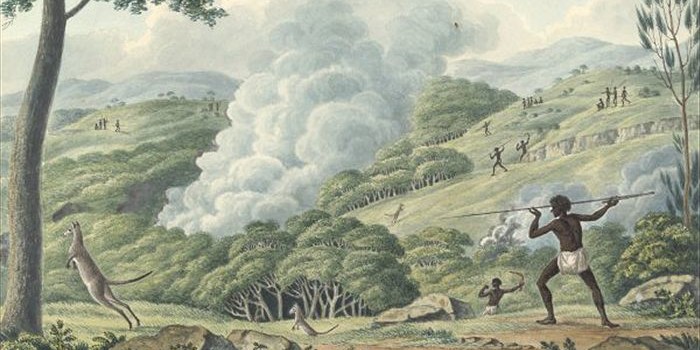
Two weeks after Black Saturday, the Prime Minister of Australia was asked in parliament: “My question is to the Prime Minister, and I recognise that he answered part of this to the member for McEwen earlier. My question relates to the Prime Minister’s comments at yesterday’s memorial service that successive governments have failed in terms of bushfire management, and also comments made by Wurundjeri elder, Aunty Joy Murphy, from Healesville who said that Aboriginal people historically burned the land every seven years for ‘cleansing and regrowth’, but Black Saturday was a ‘torture of the land’. Prime Minister, could you elaborate on your comment and, given that every inquiry since 1939 has focused on fuel reduction in fire-prone areas, do you believe it is time we learnt from Aboriginal Australians, whose firestick management practices created the bush environment that white Australians are attempting to modify to a landscape that has never existed?”
Restrictions on burn-offs increase risk of bushfires, expert warns
One of Australia’s leading fire experts has warned that the failure to conduct enough controlled burns is exposing people to another large-scale disaster, declaring the lack of intervention is creating Black Saturday-sized fuel loads.
How much prescribed burning is required?
It is safe to conclude that it is not until we undertake a 15% pa burning program that we could expect no life loss. The gain at 5%pa is small but by 8% pa it is becoming very much better. There is informed opinion amongst fire managers that 10 – 12% is the optimum for fire protection.
Fire management – what has changed?
In the last decade there have been a number of developments which are pulling Australian bushfire management in opposing directions. These include: publication of several Australian compendia on ecology and management of fires, transfer of large areas of multiple use forests into national parks and the declaration of roadless wilderness areas, listing of frequent fire as a threatening process under environmental legislation, many very large and damaging fires and subsequent government enquiries, a number of international conferences on fire management, establishment of the Bushfire Cooperative Research Centre (CRC), a current trend of global warming, declining rainfall or droughts in parts of Australia, declining forest health in long unburnt areas and the ever-increasing numbers of Australians living at the urban/rural interface. Some of these developments are tempering the counter revolution, but the overall imbalance remains.
Bushfire greenhouse gas emissions – from mild to wild
Researchers have conducted the first-ever experiments to prove that fuel reduction burning prior to wildfire decreases both the intensity of wildfire and reduces the amount of carbon and greenhouse gas emitted to the atmosphere. Nerissa Hannink reports.
Bushfires and Global Warming
A cheap system of bushfire management that worked has been replaced by an obscenely expensive one which doesn’t. Premiers, ministers, shire councils and bureaucrats are in thrall to environmental activists who have never fought a bushfire and are running a political, not a social agenda.