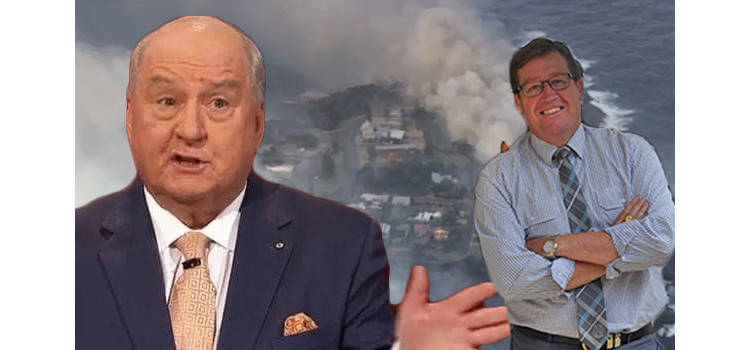
Alan slams minister’s Tathra response: ‘You are a disappointment Troy!’

Alan slams minister’s Tathra response: ‘You are a disappointment Troy!’

Mr Grant has announced an independent investigation into the callout procedures for bushfires, in the wake of the blaze that destroyed 69 homes on the south coast.
Questions are being raised about the responsibilities of, and competition between, the Rural Fire Service and Fire and Rescue New South Wales.
The RFS declined two offers of assistance before the fire jumped the Bega River and tore through the seaside town.
Several people within Fire and Rescue NSW have told Alan a “turf war” between the two organisations has been putting people’s homes and lives at risk for decades.
Emergency Services Minister Troy Grant tells Alan he won’t be taking action until an independent investigation looks into the matter.
“The RFS Commissioner has already referred this fire to the Coroner… why is that a problem?
“The working relationship between the two, I don’t think has been better for years.”
Alan, “You’re kidding me. You are a disappointment Troy, you’re miles off the pace!
“If you were returning to a home that had been burnt to the ground and you’d lost everything, you’d want a better response than Troy Grant has given me today.”
Listen to the explosive interview in full…

Forest Mismanagement has brought Unprecedented Environmental Catastrophe to California

Forest Mismanagement has brought Unprecedented Environmental Catastrophe to California

A California independent oversight committee is recommending that the state revamp its forest management strategies in order to prevent massive fires like those that plagued the state in 2017.
The Little Hoover Commission (LHC) released a report Monday that found a more proactive approach to forest management, like using practices such as thinning and controlled burns, could lessen the impact of wildfires on the environment and the budget.

Demolition moves RFS training centre closer to construction

This news article appeared in the Daily Liberal on February 2nd 2018. It is clear that the Lets put the RURAL back into the Rural Fire Service campaign is beginning to bear fruit.
Congratulations to Mayor, Ben Shields for his support.
Progress is being made on the construction of a Rural Fire Service training facility.
Dubbo Regional Council has awarded a tender for the demolition of buildings at Dubbo City Regional Airport where the training facility will be constructed.
The centre will provide specialist training in areas such as incident management, road crash rescue and fire investigation, as well as member induction training.
With a 30-year lease agreement in place, it is fair to say that the flow-on effects will be felt in the local economy well into the future, says Mayor Ben Shields.

Stories of Fatigue – Part 1

A Strike Team was sent from (name suppressed).
The strike team had been available (at their brigade stations) since 12 midday.
It was estimated that most of the crew would have been awake since 0700hrs.
It took approx. 1 hour 45 minutes to drive from (name suppressed) to a staging area.
Upon arrival, crews waited while information was gathered.
Crews were provided with water and snack packs.
They were sent to the fire ground on an evening shift.
The Strike Team was stood down at 0300hrs.
They drove back to (name suppressed).
It would be fair to say that the crew members had been awake for almost 24 hours.
Do you have a similar story?
We are hearing stories of frustrated firefighters who are deployed, only to sit around without doing much (sometimes without doing anything). This in itself is tiring.

RFSA sponsorship recipient continues research into cultural burning

RFSA sponsorship recipient continues research into cultural burning

The RFSA is to be congratulated in the continued support of volunteer firefighter, Michelle McKemey of Guyra Rural Fire Brigade, assisting her PhD research project, Cultural Burning: Using Indigenous practice and science to apply fire strategically.

Michelle started her PhD in 2014, her study involves investigation into fire ecology and empowering land managers to apply fire as a management tool.

Working with Bambai Indigenous rangers, Michelle is examining Indigenous cultural knowledge associated with fire management, as well as, conducting ecological experiments to improve understanding of fire on the landscape.

A short film detailing Michelle’s research has recently been published by the University of New England and her research group was awarded the CSIRO DNFC (Digital National Facilities and Collections) award for Indigenous Engagement.  The RFSA is pleased to support Michelle’s valuable research.

Why wildfires have gotten worse — and what we can do about it

Why wildfires have gotten worse — and what we can do about it

Megafires, individual fires that burn more than 100,000 acres, are on the rise in the western United States, the direct result of unintentional yet massive changes we’ve brought to the forests through a century of misguided management. What steps can we take to avoid further destruction? Forest ecologist Paul Hessburg confronts some tough truths about wildfires and details how we can help restore the natural balance of the landscape.
The same can be said for Australia…

You own the fuel, but who owns the fire? – Paper by Michael Eburn

You own the fuel, but who owns the fire? – Paper by Michael Eburn

In this paper, Michael Eburn and his colleague Geoff Cary argue that the statement ‘Whoever owns the fuel owns the fire’ implies a duty on landowners to manage fuel on their land to reduce the likelihood of bushfires, however started, from spreading to neighbouring properties. However, the notion ‘Whoever owns the fuel owns the fire’ has not been analysed from a legal perspective. This paper reviews Australian law to identify who is legally responsible for fire that starts on privately owned land. We argue that the correct interpretation of existing Australian law is: ‘Whoever owns the ignition owns the fire’ – that is, liability to pay for losses caused by bushfire has always fallen on those that intentionally start a fire, not on the owner of the fuel that sustains the fire. That legal conclusion could have dramatic implications for fire management policies. It will be shown that liability for starting a prescribed burn is clear-cut whereas liability for allowing accumulated fuel loads to contribute to the spread of fire is almost unheard of. As a result, we argue that the law is pushing landowners in a direction away from the policy direction adopted by all Australian governments. After identifying the current legal position, we recommend changes to align the law with the national policy direction.

Private Fire Appliances

Private Fire Appliances

Tankers trailers, slip-ons and other privately owned fire appliances must be recognised by the NSW State Government as viable firefighting capability. Unfortunately, there are many reported instances in NSW, where farmers have been prevented from using their own equipment and have been isolated from their properties by unnecessary (according to local knowledge) Police road blocks.

This post includes an embedded CFA video and comments by Michael Eburn.

NSW RFS Code of Conduct and Ethics Training

NSW RFS Code of Conduct and Ethics Training

The NSW RFS is conducting a number of Code of Conduct and Ethics training workshops in 2018.

The VFFA congratulates the NSW RFS, Professional Standards Unit on this initiative. We encourage members to attend these workshops.

The workshops are interactive and provide an opportunity to discuss the Code and how it applies to brigade life. Learning occurs through instruction, large and small group activities and sharing of member experiences.

where to buy viagra buy generic 100mg viagra online
buy amoxicillin online can you buy amoxicillin over the counter
buy ivermectin online buy ivermectin for humans
viagra before and after photos how long does viagra last
buy viagra online where can i buy viagra